Testing Method
For the testing we first had to simulate flat light conditions. This was accomplished using a photography diffuser box and an array of lights, closely matching the spectrum of natural sunlight, positioned on the sides, back, and top of the box. To mimic snow in a repeatable way, we used a cotton like material to achieve the indistinct contours of a ski slope.
Thirteen goggles were tested (4 from each of the three companies plus an extra from Shred). These goggles fell into four levels of brightness. For each user the goggle testing order was randomized within each of the levels, but the order of the levels themselves were held constant. The users were presented with two goggles at a time, the control goggle and a testing goggle, and allowed to switch between the two at will. Each goggle was ranked on metrics to compare the users' vision through the control and test goggle.
Pictures were also taken through the lenses using the same set up as for the user tests. Image analysis was then run on these pictures to extract specific characteristics of the light transmission for each lens. Using correlation results and a clustering machine learning algorithm (k-means unsupervised) to determine important individual characteristics as well as important interactions between characteristics.
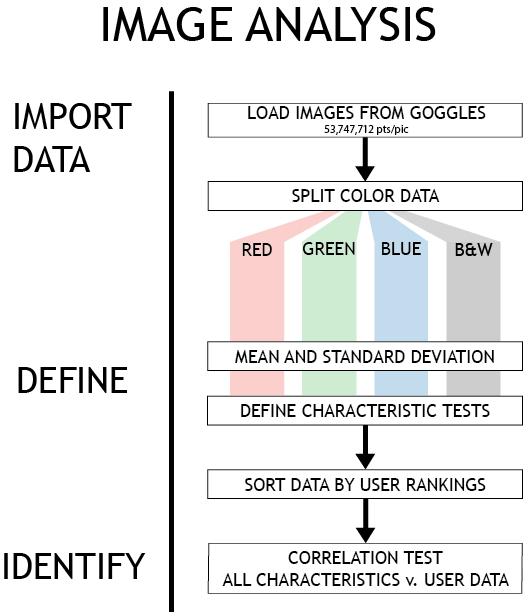
Visual Representation of the image analysis